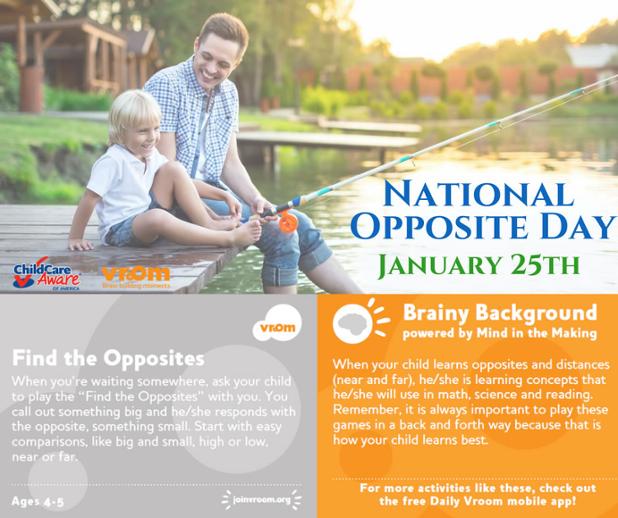
National Opposite Day is observed every year on January 25. Many enjoy using this day to try to confuse others by saying and doing the opposite of what they really mean. Why not use this day to help build your child’s brain? By the age of five, your child’s brain has reached 90 percent of its full size and their patterns for learning have been established. As a parent, you have a wonderful opportunity to play an important role in supporting development during this exciting time. Vroom helps parents by turning everyday moments into brain-building moments.

Help Build Your Child's Brain on National Opposite Day
Topics: Best Practices, Parenting
Continue ReadingProvider Health Spotlight on Yolanda Gilbert
Topics: Best Practices, Health & Safety
Continue ReadingHealth Resource Spotlight: Nutrition Education
Spotlight
Nutrition Education: Resources on the Early Childhood Learning and Knowledge Center (ECLKC) website.
Topics: Best Practices, Health & Safety
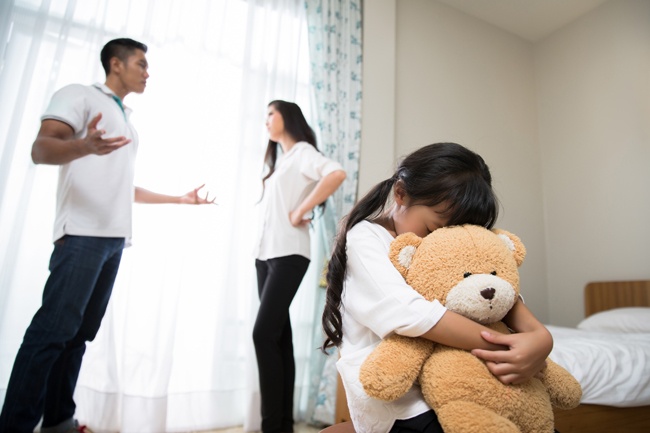
Continue ReadingHelping Children Deal with Stress
Topics: Health & Safety
Continue ReadingDecember 2016 Footnotes
Following the close of 2016, we look back and reflect on our many accomplishments—from the launch of our 10th Parents and the High Cost of Child Care report to the start of our Child Care Works movement, just to name a few. This year we have experienced tremendous growth and a steady dose of positive change. As an organization, Child Care Aware® of America has gone above and beyond to create and sustain a commitment to a quality workplace in support of children and families in policy and practice. Looking forward, we are prepared to make our impact during the first 100 days of the new administration and beyond to ensure that child care remains a top priority.
Below are some additional highlighted from December.
Topics: News
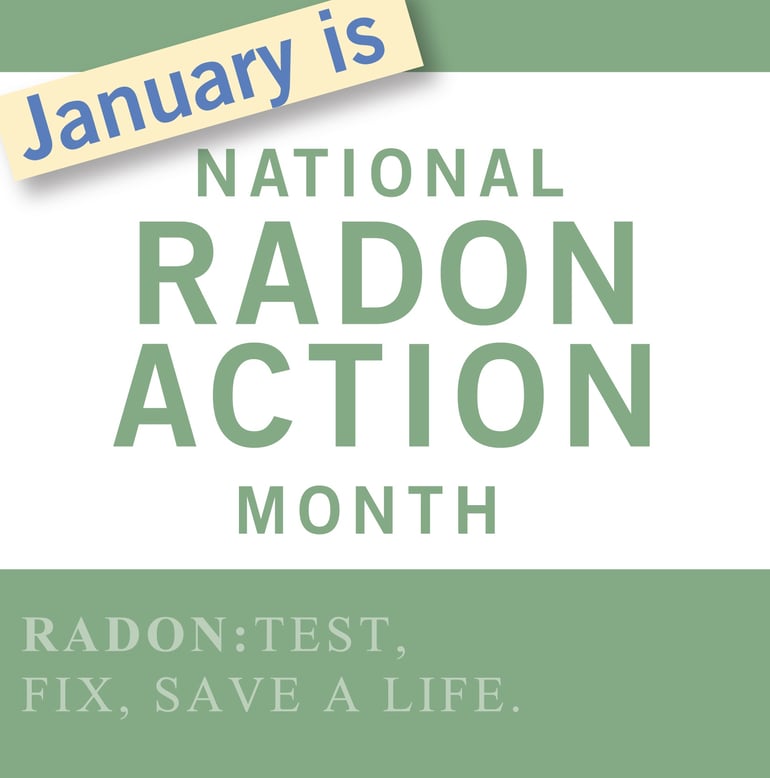
Continue ReadingTake Action Against an Undetectable Gas: It’s National Radon Action Month
This month we are acknowledging National Radon Action Month. We encourage you to test your home and workplace for radon. Radon is a naturally occurring radioactive gas released in rock, soil, and water from the natural decay of uranium. You can’t see, smell, or taste radon, but it could be present at a dangerous level in your home, workplace or child care facility. If high radon levels are detected, you can take steps to fix it and protect yourself and your family.
Topics: Best Practices, Health & Safety
Continue Reading